Happy Birthday to Pulumi open source!

One year ago today – on June 18, 2018 – we open sourced Pulumi, a new approach to multi-cloud infrastructure as code using your favorite languages. And what a year it has been!
One year ago today – on June 18, 2018 – we open sourced Pulumi, a new approach to multi-cloud infrastructure as code using your favorite languages. And what a year it has been!
Amazon Elastic Container Registry (ECR) is a fully-managed Docker container registry that makes it easy for developers to store, manage, and deploy Docker container images. ECR is integrated with Amazon Elastic Container Service (ECS), including for Kubernetes (EKS), simplifying your development to production workflow, securing access through IAM, and eliminating the need to operate your own container repositories or worry about scaling the underlying infrastructure. ECR hosts your images in a highly available and scalable architecture, allowing you to reliably deploy containers for your applications. In this article, we’ll see how Pulumi Crosswalk for AWS lets you use infrastructure as code to easily build, publish, and pull from private ECR repositories.
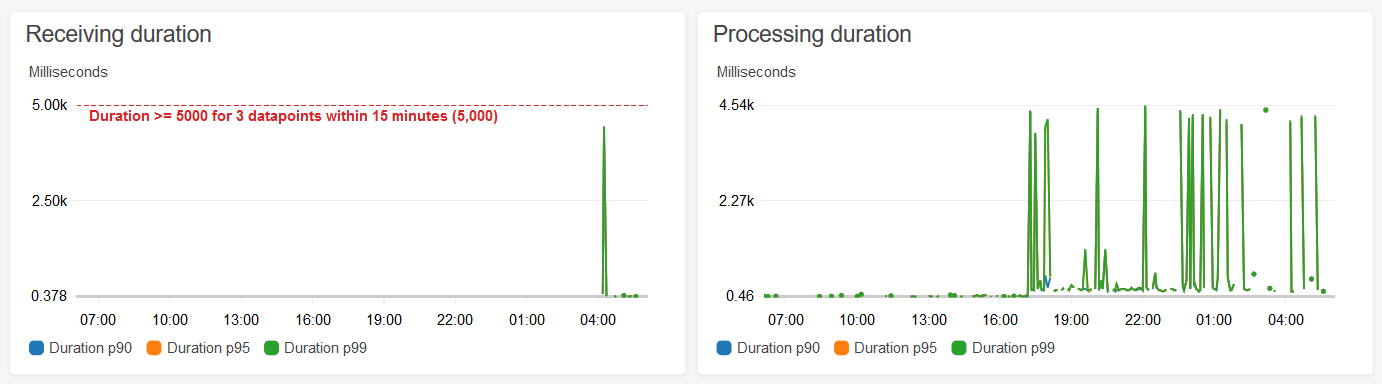
Pulumi Crosswalk for AWS modules can be used to get first class insights and visualizations directly inside your Pulumi application.
As cloud applications tend to be long-lived, we think it’s vital that it be possible to get regular insights on the performance of the application at all times. Using Crosswalk for AWS Pulumi applications allow you to easily define and visualize the appropriate metrics that show the health of your services, create alarms to let you know when something is wrong, and easily create dashboards to get live visualization of what is happening in the cloud. Because this is vital to the health of the application, we think this should be something built in from the start, and not something added after the fact as an out of band artifact.
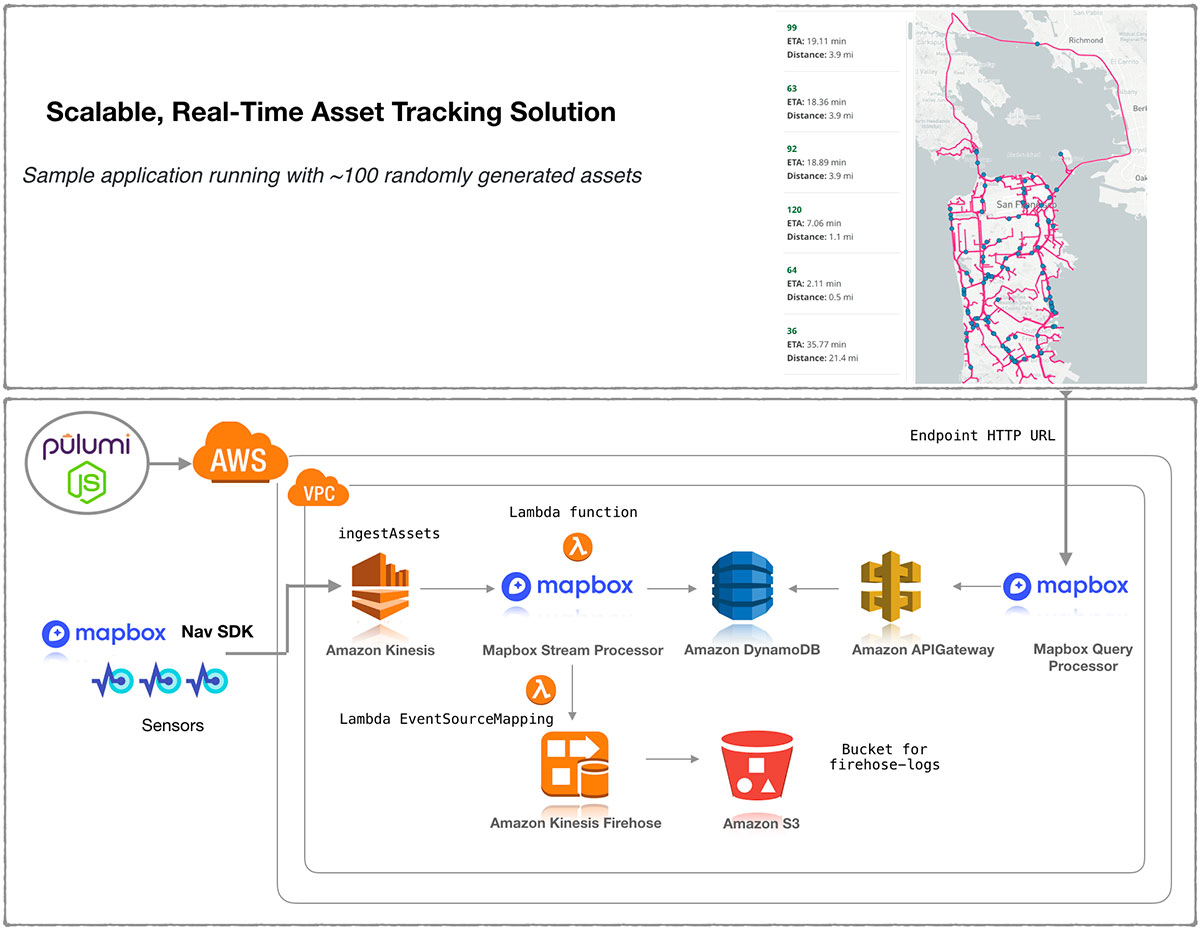
With 8 billion+ connected IoT devices and 2 billion GPS-equipped smartphones already online, logistics businesses are tracking assets at every step in the supply chain. At this scale and complexity, it is imperative to have a flexible way to ingest, process, and act upon this data, without sacrificing security or best practices.
To meet this need, Mapbox has created an Asset Tracking Solution that uses Pulumi’s open source JavaScript libraries (AWS, AWSX) available with multi-language support with Pulumi Crosswalk for AWS. Pulumi Crosswalk for AWS is an open source framework that streamlines creation, deployment and management of AWS services with built-in AWS Best Practices and minimal lines of code in common programming languages.
In this blog, we will show snippets of the Javascript code that embraces the power of Pulumi to program AWS service APIs to create the Mapbox solution. To see the full architecture in action with a live bike race across America, please refer to this webinar recorded on June 13th 2019 and the Mapbox asset tracking solution. Also refer to this blog of the Race across America showcased live during the webinar tomorrow.
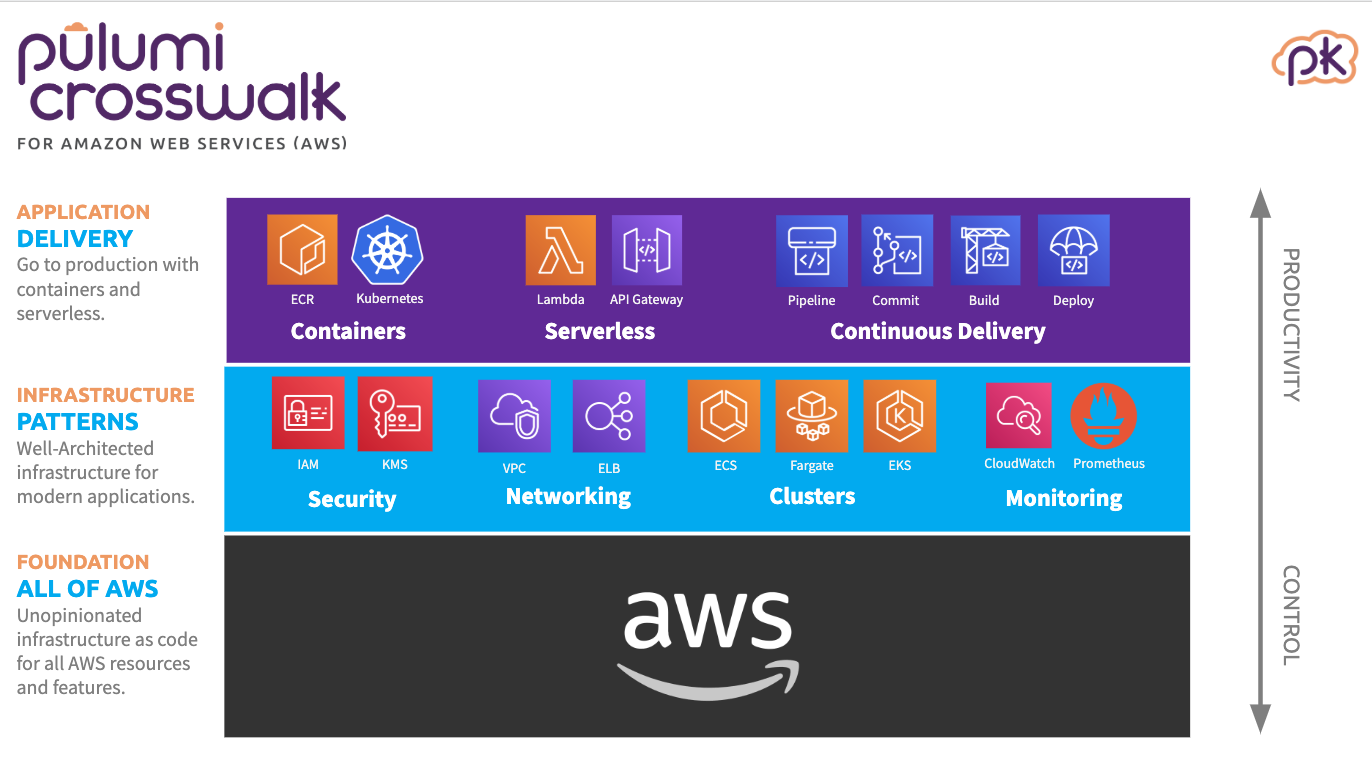
Amazon Web Services provides an incredible platform for developers to build cloud-native applications, and is used by millions of customers of all sizes. The building block services that AWS offers enable teams to offload undifferentiated heavy-lifting to AWS. To maximally benefit from these services though, cloud engineering teams must learn how to compose all of these building blocks together to build and deliver their own applications. Today, this is still too hard. Getting from your laptop to a production-ready AWS deployment frequently takes days or weeks instead of minutes or hours. And AWS building block services frequently leave you to re-implement (and re-discover) best-practices instead of providing these as smart defaults.
Pulumi Crosswalk for AWS is a new open source library of infrastructure-as-code components that make it easier to get from zero to production on AWS, easier to adopt AWS best practices by default, and easier to evolve your AWS infrastructure as your application needs mature.
While some people coming to Pulumi are entirely new to Infrastructure as Code, increasingly teams are moving from other tools - whether cloud-specific in the form of CloudFormation or ARM Templates, or cloud-agnostic tools such as Terraform. In these organizations, new infrastructure provisioned with Pulumi must co-exist with existing resources provisioned with other tools, and often by different teams. For example, it’s common to see an application team deploying into a VPC owned and managed by a network operations team.
Pulumi supports
this kind of workflow
natively using the StackReference
type from the Pulumi SDK. Integration with the most popular
cloud-specific tools have been supported by Pulumi since the earliest
days:
The aws.cloudformation.getStack()
function can be used to obtain the outputs from a CloudFormation
Stack.
The get
method of the
azure.core.TemplateDeployment
class can be used to obtain the outputs of an ARM Template Deployment.
We recently added similar support for reading the outputs of a Terraform
state file - both from local .tfstate files, and from all of the
remote state backends supported by Terraform. This is exposed via the
terraform.state.RemoteStateReference type in the
@pulumi/terraform
NPM package.
In this post, we will work through an example that shows how to use Pulumi to create Jupyter Notebooks on Kubernetes. Having worked on Kubernetes since 2015, a couple of critical benefits jump out that may resonate with you as well:
nginx-ingress-controller that we use here.
One of the most critical components of an application’s infrastructure is its database, and one of the most popular databases in use in the cloud today is MySQL.
Pulumi can already be used to create managed MySQL instances in a wide variety of clouds, including AWS, Azure and GCP. In addition to this, Pulumi recently added support for managing the MySQL instances themselves to manage permissions, create databases, and other common tasks.
In this post, we’ll walk through a quick tutorial of how to use this new Pulumi MySQL provider to manage existing and new MySQL databases.
In this blog, we will work through an example that shows how to use Pulumi to enable GitLab-based continuous delivery with your Kubernetes workloads on Amazon EKS. This integration will work just as seamlessly for any Kubernetes cluster, including Azure AKS or Google GKE, using the relevant Pulumi libraries for Azure and GCP.
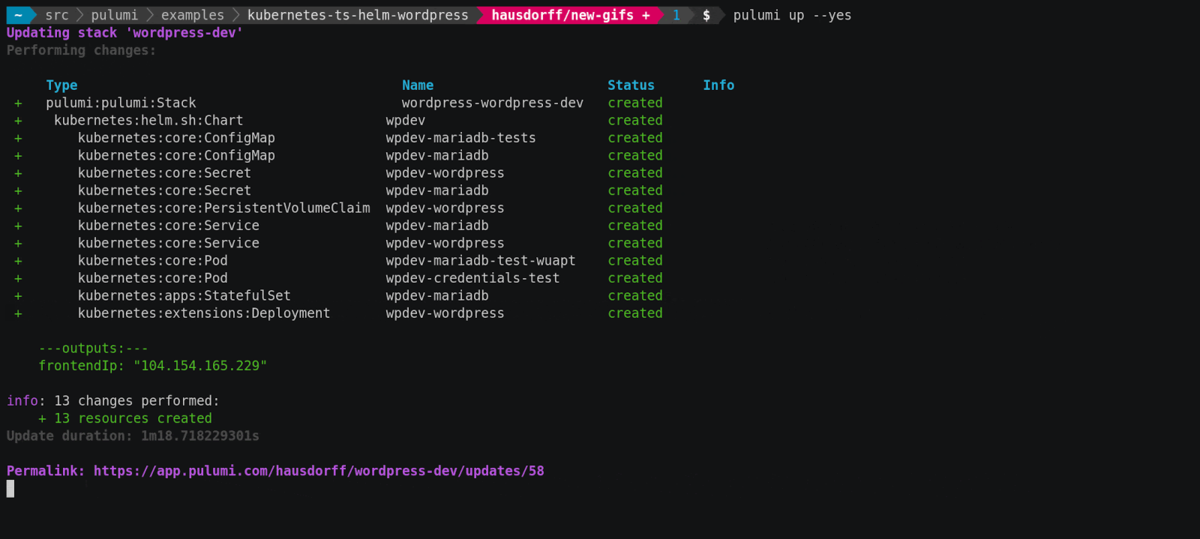
Kubernetes is a powerful container orchestrator that is being adopted rapidly across the industry. At the same time, it is notoriously complex and presents a steep learning curve for newcomers. Nobody likes programming in YAML, and templates make it even harder. It’s difficult to understand the state of the cluster – Did my deployment succeed? Why isn’t my app working? And we often need to manage hosted cloud resources in addition to Kubernetes ones.
In this post, we will see how Pulumi can help you tame these issues and make Kubernetes more accessible, using familiar languages and your favorite tools. It’s simply Kubernetes made easy!