Posts Tagged aws

Protecting Your APIs with Lambda Authorizers and Pulumi
Protecting Your APIs with Lambda Authorizers and Pulumi

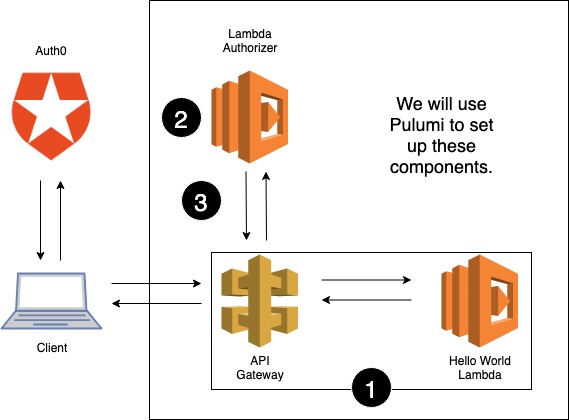
Creating serverless applications just got even easier! You can now protect your application APIs in just three easy steps. We’ve already posted about how easy it is to create serverless apps in Pulumi. Now, we’re helping you simplify protecting those apps with API Gateway and Lambda authorizers.

With Pulumi’s new AWSX package, you can quickly define a Lambda and an AWS Lambda authorizer to protect it. We’re once again harnessing the power of Lambdas as Lambdas to allow developers to focus on writing code.

Today, we will walkthrough creating a simple serverless app using AWS and Pulumi. We will simplify implementing the OAuth protocol by using Auth0 and AWS Lambda authorizers to authorize users. Auth0 provides a universal authentication and authorization platform for applications. It has become an extremely popular platform for user management because Auth0 makes OAuth easy.

Read more →

Kubernetes RBAC in AWS EKS with open source Pulumi packages

One of the most common areas Kubernetes operators struggle with in production involves creating and managing role-based access control (RBAC). This is so daunting that RBAC is often not implemented, or implemented halfway, or the configuration becomes impossible to maintain.

Fortunately, Pulumi makes RBAC on Kuberenetes so easy that you’ll never create an insecure cluster again. In this post, we will contrast the traditional way of working with RBAC on EKS with using Pulumi.

Read more →

Programming the Cloud with Python

Programming the Cloud with Python

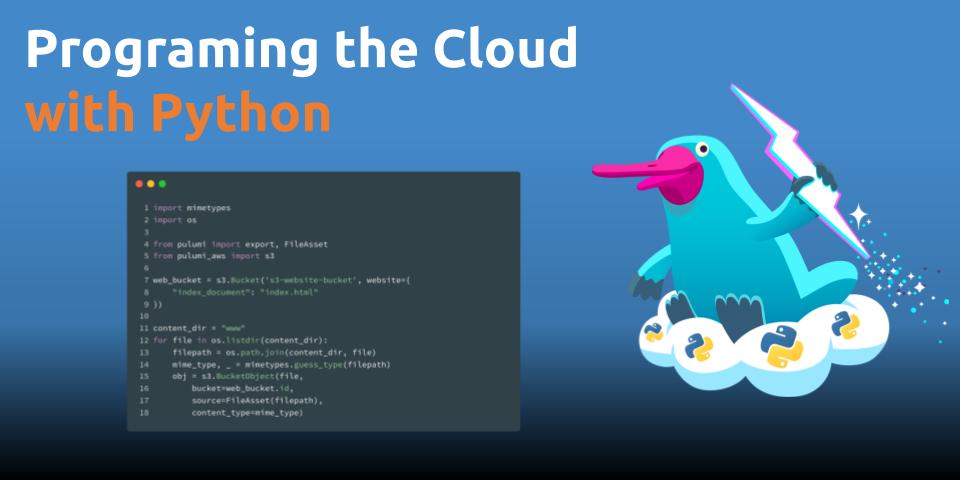
Across the industry, the popularity of Python is exploding. Amongst our own customers at Pulumi, who automate their infrastructure using Python, we’ve seen the same. Stack Overflow wrote about the astounding growth of Python: The term “fastest-growing” can be hard to define precisely, but we make the case that Python has a solid claim to being the fastest-growing major programming language. – David Robinson, Stack Overflow Since Python is not a new language, what could be driving this incredible adoption curve?

Read more →

Unified Logs with pulumi logs

Unified Logs with pulumi logs

Pulumi makes developing and deploying rich serverless and container-based applications a breeze. But how do you monitor and observe those applications while they are being developed and once they are deployed? There are many great answers: from the built-in capabilities of the underlying cloud services (Lambda, ECS, Kubernetes, and more), to great 3rd party solutions like IOpipe and Epsagon which we highlighted recently on this blog.

The Pulumi CLI provides another way to do logging, without requiring the additional setup of these existing solutions and seamlessly integrated into your Pulumi development workflow. The pulumi logs command provides a great first place to start for understanding your Pulumi application’s behavior. Especially during development, this command provides direct insight into the behavior of your application, bringing together logs across all of the different forms of compute you are using - from code running in serverless functions to containers to VMs.

Let’s take a quick look at pulumi logs and some of the ways it can be used as part of the inner loop of your Pulumi development.

Read more →

Easy Serverless Apps and Infrastructure

Easy Serverless Apps and Infrastructure

With Pulumi, you can create, deploy, and manage any cloud resource using your favorite language. This includes application and infrastructure related resources, often in the same program.

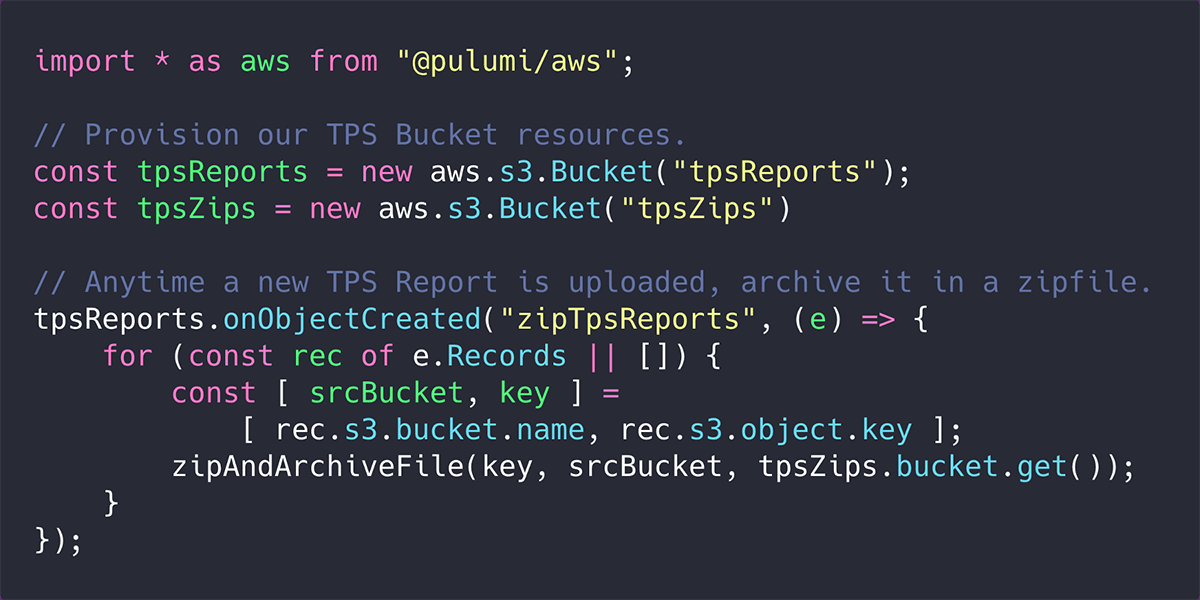
One area this gets really fun is serverless computing. Because we’re using general purpose languages, we can create resources, and then wire up event handlers, just like normal event-driven programming. This is the way serverless architecture should be!

In this article, we’ll see how. There’s a broad range of options depending on what you want to do, and how your team likes to operate. We’ll be using Amazon Web Services (AWS) and TypeScript, but other clouds and languages are available.

Read more →

Easily Create and Manage AWS EKS Kubernetes Clusters

Easily Create and Manage AWS EKS Kubernetes Clusters

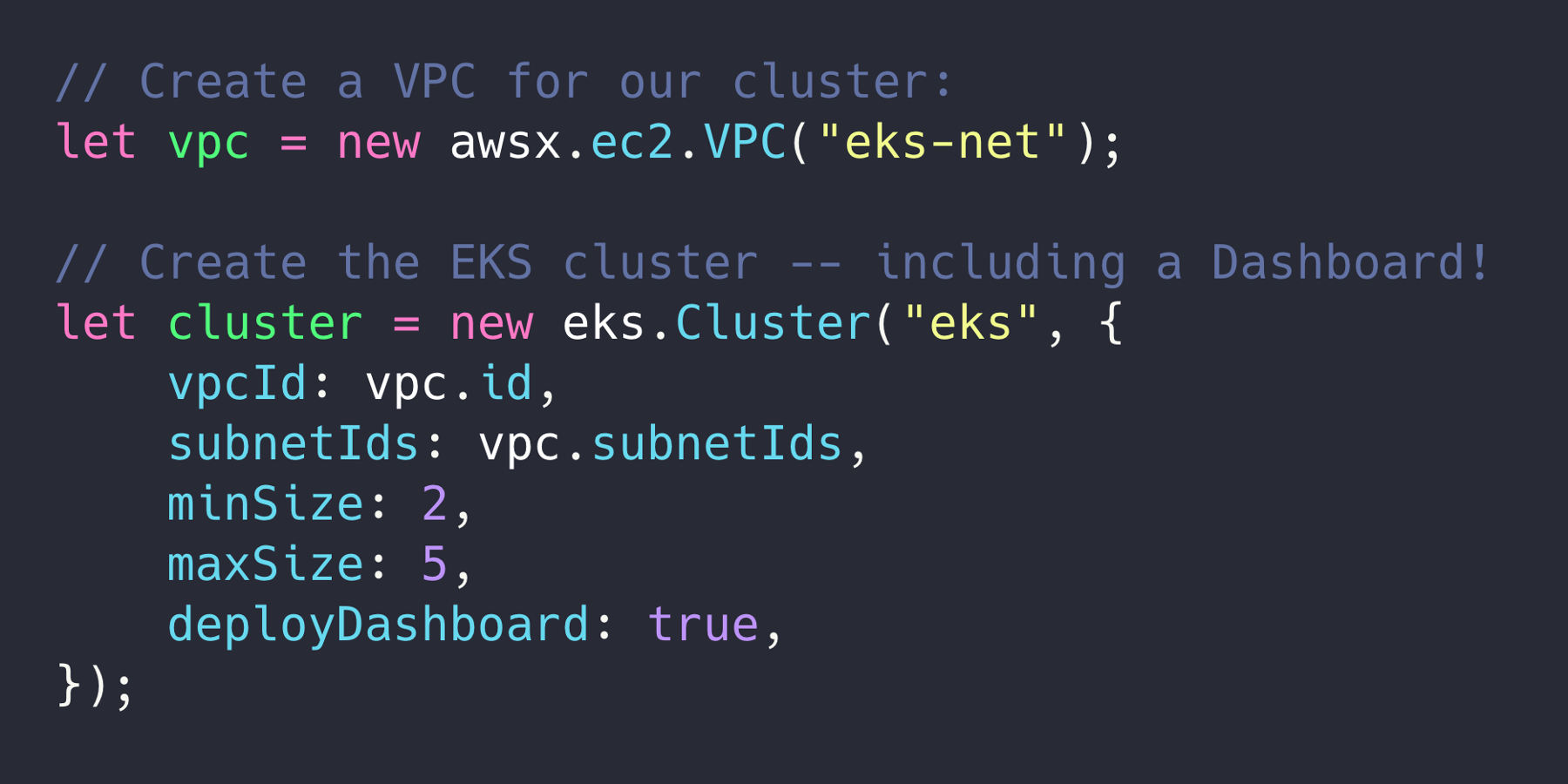
Provisioning, managing, and monitoring a Kubernetes cluster is no easy task. AWS now offers EKS to ease a lot of that burden – but it’s still difficult to get up and running. Pulumi’s infrastructure as code to the rescue! We can now provision an entire EKS cluster with a CLI single gesture, thanks to the @pulumi/eks package. Let’s see how.

Read more →

Serverless on AWS with Pulumi: Simple, Event-based Functions

One of Pulumi’s goals is to provide the simplest way possible to do serverless programming on AWS by enabling you to create cloud infrastructure with the real programming languages that you are already using today. We believe that the existing constructs already present in these languages, like flow control, inheritance, composition, and so on, provide the right abstractions to effectively build up infrastructure in a simple and familiar way.

In a previous post we focused on how Pulumi could allow you to simply create an AWS Lambda out of your own JavaScript function. While this was much easier than having to manually create a Lambda Deployment Package yourself, it could still be overly complex to integrate these Lambdas into complete serverless application.

Read more →

Program the Cloud with 12 Pulumi Pearls

In this post, we’ll look at 12 “pearls” – bite-sized code snippets – that demonstrate some fun ways you can program the cloud using Pulumi. In my introductory post, I mentioned a few of my “favorite things”. Now let’s dive into a few specifics, from multi-cloud to cloud-specific, spanning containers, serverless, and infrastructure, and generally highlighting why using real languages is so empowering for cloud scenarios. Since Pulumi lets you do infrastructure-as-code from the lowest-level to the highest, we will cover a lot of interesting ground in short order.

Read more →